nagrak
indonesia is sedong a vast, sprawling country. It’s hard to even think of it
as a single country – it’s more like a gargantuan tree nagrak sedong with branches
that extend out into various parts of the Indian and Pacific Oceans.
And there are a lot of branches to the Indonesian tree. What we know of as Indonesia is comprised of a total of 17,508 islands extending 5,150 kilometers (3,200
miles) east to west in Southeast Asia and Oceania. The sum of these
islands cover approximately 1,919,440 square kilometers, making
Indonesia the world’s 16th largest country in terms of land area. Of
these 17,508 islands, only 6,000 are currently inhabited.
With so many islands, it’s not hard to see how Indonesia got its name – the name Indonesia comes fromIndus, the Latin name for the land beyong the Indus river, and the Greek nèsos, meaning island.
The
largest Indonesian islands are Sumatra, Java, Kalimantan (Indonesian
Borneo), Sulawesi, and the Indonesian part of New Guinea (known as Papua
or Irian Jaya). Click here for an easy guide to Indonesia’s islands.
Indonesia’s History & Culture
nagrak sedong Indonesia has a rich and fascinating history. The majority of Indonesia’s modern population is made up of Austronesian people,
who originally migrated to South East Asia from Taiwan. They arrived in
Indonesia around 2,000 BC and quickly spread throughout the
archipelago, pushing the indigenous Melanesian people to the far eastern
regions.
Trade
contracts eventually brought outside cultural and religious influences
to Indonesia from India, China, and mainland Southeast Asia. Starting
from the 7th century, the powerful Srivijaya kingdom flourished as a
result of the Hindu and Buddhist influences that were imported into
Indonesia along with traded goods. Srivijaya was one of the first
Indian-ized empires and grew up around the coast of Sumatra, serving as
the hub of a trading network that reached to many parts of the
archipelago.
On
neighboring Java, the Buddhish Sailendra and Hindu Mataram dynasties
thrived and declined, leaving behind vestiges of grand religious
monuments such as karangsembung cirebon Sailendra’s Borobudur and Mataram’s Prambanan.
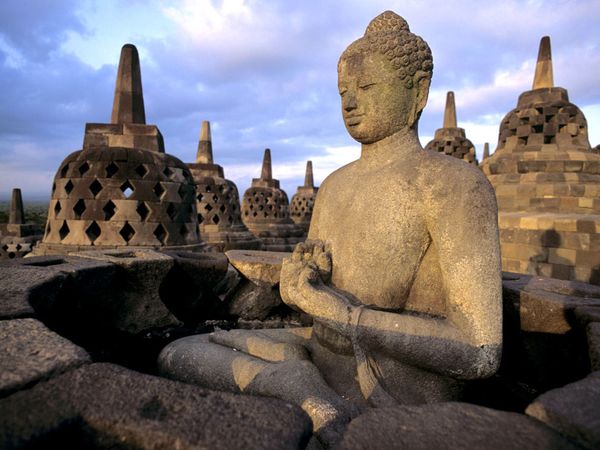
Borobudur, Java, Indonesia
The
last and most powerful of these early Hindu-Javanese kingdoms was the
Majapahit empire, whose influence stretched over the majority of
Indonesia.
Although
the very beginning of Islamic influences dates back to the 8th and 9th
centuries, the earliest evidence of Islamized populations is not found
until the 13th desa karang sembung century. By the time Marco
Polo visited Northern Sumatra at the end of the 13th century, the first
Islamic states were already established there. Other Indonesian areas
gradually adopted Islam and it became the dominant religion in Java and
Sumatra by the end of the 16th century. Indonesia is now the world’s
largest Islamic nation.
It
was also around this period that Indonesia’s abundant spices attracted
the attention of European traders. Portuguese merchants first came to
the trading port of Malacca in 1511 looking for spices such as cloves,
nutmeg and mace. Such spices, rumored to cure everything from the plague
to venereal disease, were literally worth their weight in gold and the
Portuguese sought to monopolize the sources of the spices. But Dutch and
British traders soon followed.
Eventually,
the Dutch won and overtook the spice trade. The Dutch East India
Company (VOC) soon established a spice monopoly that lasted well into
the 18th century, until the VOC’s bankruptcy, and formal dissolution.
The government of the Netherlands then stepped in and established
Indonesia as as a Dutch colony. The 19th century saw the Dutch
cultivating sugar and coffee on the island of Java, which was soon
providing 3/4s of the world supply of coffee.
The
Dutch ruled Indonesia for nearly three centuries, but by the turn of
the 20th century, the Indonesians were more than ready for independence.
It came in the form of World War II and the Japanese occupation of Indonesia.
Because
the Netherlands was under German occupation, it had little ability to
defend its colony from the Japanese army and less than 3 months after
Japan’s initial attacks on Borneo, the Japanese ran the Dutch forces out
of Indonesia. Most of the Indonesians welcomed the Japanese, seeing
them as liberators from their Dutch colonial masters, but the optimistic
sentiment soon changed as Indonesians were expected to endure even more
hardship for the war effort.
Still,
the Japanese occupation of Indonesia, which lasted from 1942 to the end
of WWII in 1945, marked a critical turning point in Indonesian history.
You
see, the occupation was the first serious challenge to Dutch rule in
Indonesia. Plus, unlike the Dutch, the Japanese faciliated the
politicization of Indonesians down to the village levels – educating,
training, and arming many young Indonesians in the process. By
destroying the Dutch colonial regime and facilitating Indonesian
nationalism, the Japanese occupation created the perfect conditions for
what led to the Indonesia Revolution, which would hardly have been
feasible before WWII.
Within
days of the Japanese surrender, Indonesian independence was declared.
The Netherlands didn’t agree and a 4-year long diplomatic, military and
social struggle ensured, ending in the Netherlands recognizing
Indonesian sovereignty in December 1949.
Indonesia
now is a melting pot of over 300 ethnic groups, each with cultural
identities developed over centuries and influenced by all the cultures
that have been present in Indonesia throughout its rich and diverse
history: Indian, Arabic, Chinese, and European.
You
can find these influences throughout Indonesia. Traditional Javanese
and Balinese dances, for example, contain aspects of Hindu culture and
mythology. The current legal system is based on the old Dutch penal code
and several Dutch words have managed to find their way into the
Indonesian language. The art and culture of Indonesia shows influence
from the Far East, the Middle East, and Europe.
It’s no wonder Indonesia’s national motto is “Bhinneka Tunggal Ika” – literally, “many, yet one” and a reflection of their belief in “unity in diversity.”
Indonesia’s Language
The
official language of Indonesia is ‘Bahasa Indonesia.’ There are also
several hundred local languages, such as Javanese or Papuan languages.
Most Indonesians speak their ethnic language as their mother tongue as
well as the official language of Bahasa Indonesia.
Indonesia’s Religion
Indonesia
is the world’s largest Islamic country, but the government of Indonesia
officially recognizes five other religions: Hinduism, Buddhism,
Protestantism, Catholicism, and Confucianism.
nagrak sedong
nagrak sedong Did
you know that over 150 of Indonesia’s 17,508 islands are active
volcanoes? Indonesia is one of the most geographically and geologically
interesting countries on Earth. There are over 400 volcanic mountains
that dot the islands of Indonesia. These islands have a huge impact on
both the Australian and Pacific tectonic plate. The Australian plate
changes slowly moves slowly upwards into the small plates of the Pacific
plate which moves southward. The islands of Indonesia are stretched out
between the lines of these two plates.
This
interesting situation makes Indonesia one of the most changing
geological areas in the world. Indonesia experiences three vibrations
every day, at least one earthquake a day, and one volcanic eruption
every year. Indonesia was also the site of two famous 19th century
volcanic eruptions – Tambora and Krakatau – as well as the epicenter of
the 2004 Southeast Asian tsunami.
Indonesia
spans a range of 1,919,000 square kilometers and shares land borders
with Malaysia, Papua New Guinea, and East Timor, all of which to its
uniquely rich cultural diversity.
Indonesia’s
climate is tropical – hot and humid – although its high mountain peaks
can get quite cool. The year is divided into a wet season and a dry
season but because Indonesia is located at the equator, the temperatures
don’t vary much from month to month. The coastal areas stay steady at
around the mid to upper 20s Celsius (low to mid 80s Fahrenheit) all year
long.

0 Komentar untuk "nagrak sedong word in the home"